Sunday, April 7, 2013

Critics of the Page 3 Girl Ban and Victoria Secret Ad are One in The Same


Whenever feminists get involved in campaigns against depictions of nude or semi-nude women, the same accusations fly. They are old-fashioned prudes. They can’t appreciate that sex and nudity is a part of life. They are hypocrites who celebrate The Vagina Monologues or “artistic” nude photography because the depiction of female nudity or sexuality must be on their terms. They don’t understand that the woman chose to be nude, and because all choices must be feminist, it therefore is not sexist. The problem is that the people criticizing the campaign to ban The Sun’s page 3 girls don’t understand the importance of context (This is a general interest newspaper) or that their criticisms are far more hypocritical and conveniently sexist than they realize.

Recently, parents and commentators such as Amy Gerwing railed against the Victoria Secret “Bright Young Things” advertisement and PINK line, even though the models were in their 20s and the lingerie featured was not scandalizing to any degree. It isn’t news that young women sometimes buy thongs, especially ones emblazoned with flirtatious messages. In a letter to the company, an angry father said that young women would be discouraged from becoming doctors or lawyers because everyone knows that wearing neon colored underwear and challenging one’s mind is mutually exclusive. The people criticizing the advertisement and PINK line seemed to think that young women couldn’t possibly want to buy pretty underwear unless a young man were there to view it. The underwear is worn equally, if not more so, for the judgment of the girls in the high school locker room as it is for a boy. There are so many gender assumptions wrapped up in this benevolent sexism dressed up as parental concern, that it would take an entire article to point them all out. But the differences between the Bright Young Things advertisement and the campaign against page 3 girls are stark.

Young women need underwear and Victoria Secret provides it. It is a company that targets women of all ages, including teenagers. The Sun is a newspaper sold to everyone, and as a Bloomberg Businessweek article points out, women constitute 45 percent of its readership. The inclusion of a page 3 girl suggests that the consumption of news is for men, plain and simple. Getting rid of it is not a puritanical move. The Sun could include a man and a woman on Page 3 or provide a photo of a man on a separate nearby page. If the newspaper wanted to attract readers on those terms, it could.

I suspect Rupert Murdoch would have never entertained such an idea, as the same men who argue against prudery would likely find a half naked man wearing tight boxer shorts (placed expressly for the purpose of being leered at as a perfect cut of meat) distasteful and offensive. Their gaze has been catered to for so long that the mere suggestion that women and gay men’s objectifying gaze should have equal real estate is repellant to them. If they won’t cede any ground in the public square that is the general news source, they should stay quiet when feminists ask that the page 3 girl be abolished.

To be clear, it is always wrong to make people feel that their worth is tied up with their physique, and it would be better for everyone if men and women were not objectified in our media. But I think it’s interesting to consider why corporations would rather abandon the objectification of women if they can try to have their cake and eat it too by catering to all sexual tastes. The reluctance to do so seems to be wrapped up in the idea that it is inappropriate or damaging for women to have sexual longings to the same degree men do. That is the thread that connects Victoria Secret’s “Bright Young Things” ad and the page 3 girl ban. The same people who believe it is okay for women to exist as sexual objects in a general interest newspaper for the satisfaction of half its readership, ignoring women’s sexual interests, probably believe young women should be protected from their own sexuality.

Tuesday, April 2, 2013

Yahoo news: Why didn't the Princeton Mom tell her boys to marry well?


Last week, a brilliant rocket scientist died, but she was a brilliant rocket scientist whose husband and kids said she made a great beef stroganoff.
BuzzFeed has an excellent rundown on the recent controversy over the New York Times’ obituary ofYvonne Brill, whose accomplishments as an inventor and scientist were not listed in the obituary until after it had noted that she was a wife and mother:
[T]he idea that young women need to have both a career and a husband (and children) to be truly successful hangs over them starting in adolescence. Call it the ‘Phantom Husband’—the omnipresent relationship that is so frequently presumed to define a woman and her choices, sometimes even before they meet.
This comes on the heels of a now-infamous essay that Princeton alumna (and mother of two current students) Susan Patton wrote for the university’s school newspaper, the Daily Princetonian, encouraging its female undergraduates to prioritize finding a husband while on campus.
The fact that Susan Patton frames her editorial as an open letter to all young women of Princeton—that if she had daughters, this would be the advice she’d give them—is problematic. Because, one would hope, if she’d be so eager to prioritize her daughters’ quest for smart, driven, and potentially successful husbands, you’d think she’d want her sons to find smart, driven, and potentially successful wives. In effect, you’d think she’d want all of her kids, regardless of gender, to be in a relationship that fits some mold of what we know as a “power couple.”
Power couples, as we define them, may exist on the macro level; say, the Clintons or Brangelina. Or they can be on a micro level, as in your hometown’s local husband-and-wife lawyer team who throw the best holiday parties every year and run marathons together. But in both cases it’s a common and generally complimentary epithet—a couple of equal or similar prowess and accomplishment with mutually beneficial sets of skills, relationships, and networks. And they are, for the most part, a recent invention: Before women started obtaining college degrees and entering the workforce en masse (and, of course, before gay couples embarked on the long road to mainstream social acceptance) the female half of a “power couple” typically needed to come from family money—or from a previous husband. They’re much more common than they could have been before.
But Susan Patton was giving her controversial advice to her hypothetical daughters, not her real-life sons. And therein lies the reality: In the business world, participation in a “power couple” is optional if you’re male. If you’re female, it’s implicitly pushed on you as a requirement. A woman in the professional world is, as in both Susan Patton’s editorial and Yvonne Brill’s obituary, instantly defined by her choice of husband.
This rears its head particularly high in the political world. When a US first lady takes too much of the spotlight, as with Michelle Obama presenting the best picture award at this year’s Oscars or Hillary Rodham Clinton running for US Senate with her husband still in office, there’s inevitable sexist scorn, as though she doesn’t “know her place.” But if a female politician’s husband is a comparative underachiever, the critical instinct is to wonder why he isn’t more successful. It’s considered out of the ordinary that German chancellor Angela Merkel’s husband is a chemistry professor who keeps a low profile—why isn’t he some kind of political heavy-hitter, too?—and it’s the butt of many a joke Down Under that Australian prime minister Julia Gillard’s long-term partner is a hairdresser.

Yahoo News wrote a thoughtful piece in response to the Princeton mom controversy. By the way, do you think every major news publication  would call a man who wrote an elitist sexist piece "Princeton Dad"? I'm not entirely sure, but perhaps it would have been a catchy phrase to use for someone who is not a famous op-ed columnist. 
The most powerful women in the world have written and spoken extensively about carefully choosing a partner and, in effect, “marrying well.” Facebook COO and Lean In author Sheryl Sandberg has encouraged women to “make your partner a real partner,” something that admirably extends to an even split of household work but also to professional success: “households with equal earning and equal responsibility also have half the divorce rate,” she has noted. PepsiCo CEO Indra Nooyi has said:“You have to pick the right husband…[My husband] is a great guy and he has been a great support and I do not know where I would have been without him. I would say that without a doubt.”
Granted, Sandberg and Nooyi were hardly encouraging women to make sure they bagged billionaires, and in Nooyi’s case, she was speaking to a male interviewer and did mention that in his case, he’d be looking to choose the right wife. But, as has been all too extensively documented of late, with Sandberg’s Lean In and Anne-Marie Slaughter’s “Why Women Still Can’t Have It All” cover story in the Atlantic igniting a new firestorm of discussion over women’s status in the professional world, it’s usually a non-story when a successful man happens to be unmarried and child-free (unless a society magazine is compiling an “Eligible Bachelors” list). If a successful woman has neither partner nor children, the questions start flying. If she’s (relatively) young, is she on the lookout for the right man? Does she want to pull back from the business world to have children? If she’s older, and never started a family, does she regret it?
Call it salt in a wound, but the thinking that drove Susan Patton to author her letter to the Daily Princetonian is very provocative: Being married isn’t enough for high-achieving women. Being married to a supportive husband isn’t enough, either. He’s got to be just as successful, or even more so, than his female spouse.
Frankly, it’d be great if there were some powerful women out there who were vocal about not being in power couples. As much as it’s an aspirational term of supposed spousal equality, the reality is that it’s weighted with gender bias. It’d be great if there were a few C-level women who said that career and close friendships outweighed the need to have a partner and that they really, truly had no regrets. Or, even better, if there were a few who are proud to have loving, supportive partners who work part time or freelance in order to stay home with the kids (or the dogs, or both). Would it really be that radical for a female billionaire to say what a great cook her husband is?
Follow Caroline McCarthy on Twitter @caro. We welcome your comments at ideas@qz.com.

Tuesday, March 26, 2013

A Reaction to Lean In: I Want a Feminist "Catfight"


A common misconception among feminists and those curious about feminist thought is that women need to stop criticizing other women. Taking it further, some people believe feminists must not criticize other feminists. Sheryl Sandberg talks about the shortness of Marissa Mayer’s maternity leave and the criticism that followed her announcement in her new book, “Lean In.” I agree with her that Mayer has been labeled “the CEO that represents all working mothers,” and that is unfair. I think some of the criticism of Mayer’s maternity leave, her personal choice, is undeserved. But I disagree with her assertion that women need to stop criticizing each other, especially feminists who criticize other feminists.

Political and social movements need introspection. There are plenty of groups that could benefit from a little introspection. The Republican Party is a great example. Feminists may agree on some of the main problems that need to be addressed, such as pay equity, maternity leave, and rape culture, but feminists differ on what solutions are best. Some feminists are “choice” feminists who believe all choices women make should be celebrated and others believe that the reasons behind those choices are still relevant and influenced by traditional gender roles, as Sandberg does.

Sandberg laments the fact that Betty Friedan and Gloria Steinem did not get along, to say the least. Friedan considered some of Steinem’s statements about marriage and relationships with men too extreme. In the book “Interviews with Betty Friedan,” edited by Janann Sherman, Friedan said of her feud with Steinem:

“They can’t seem to understand that every important movement is going to have a certain amount of fighting over turf. Men do it all the time in politics…When she said marriage was a form of prostitution, I spoke up and criticized her. Her view had nothing to do with my kind of feminism and I said so…That extreme kind of thinking tends to come from women who hate having to deal with the complexities of juggling a career and a family and so, almost literally, they want to throw the baby out with the bathwater.”

What Sandberg fails to realize is how these disagreements between feminists of different eras helped grow the feminist movement. Steinem wanted to bring feminism in a new, and I would argue a more inclusive and progressive, direction. For example, “The Feminine Mystique” benefitted many white middle class women living as housewives, but it didn’t apply to women of a different sociological background, who always had to work. Their issues were different. Friedan was also considered hostile to the gay rights movement. In a New York Observer article, Alix Kates Shulman said Friedan called feminist lesbians the “lavender menace.” In “The Feminine Mystique,” she argued that housewives who smothered their children with affection could turn their sons gay through resentment of women, and in the context of her argument, I doubt this was considered a positive result. Friedan wrote:

“Whether or not there has been an increase of homosexuality in America, there has certainly been in recent years an increase in its overt manifestations. I do not think this is unrelated to the national embrace of the feminine mystique. For the feminine mystique has glorified and perpetuated in the name of femininity a passive, childlike immaturity which is passed on from mothers to sons, as well as daughters.  Male homosexuals—and the male Don Juans, whose compulsion to test their potency is often caused by unconscious homosexuality—are, no less than the female sex-seekers, Peter Pans, forever childlike…”


Steinem also made major inroads to include more feminists of color and allied the feminist movement with the civil rights movement. The feminist conversation is still too dominated by white women, especially upper-middle class white women, but Steinem made progress in that regard. None of this information is meant to demonize Friedan, who founded The National Organization for Women and the National Association for Repeal of Abortion Laws and fought hard for equal pay, or celebrate Steinem, who has her share of critics over statements she has made about transsexuals and the legalization of prostitution. The feminist movement desperately needed both Friedan and Steinem’s contributions, despite their disagreements. Without one, there wouldn’t be the other.

We can’t discourage feminists from arguing with each other. I understand that Sandberg is concerned with the portrayal of women engaging in perceived “catfights.” She wants feminists to work together in order to solve major problems. But feminism’s birthing pains helped it grow into a stronger, more diverse movement. As Sandberg points out, women have major hurdles to jump over. Women are still underrepresented in management and held back from pursuing promotions and engaging in office discussions. If “Lean In” proves anything, it is that the solutions to these problems will not be easy to find or straightforward. The issues she describes are nuanced and complicated. These are the kind of problems that must be solved by a diverse group of people with conflicting views. We need creative solutions, which we will never hope to find if we brush over our conflicts or shut out people or who are likely to disagree.


Saturday, March 23, 2013

Interview with Samhita Mukhopadhyay: Outdated


Samhita Mukhopadhyay, the editor of Feministing.com, answered questions

about her book, “Outdated: How Dating Is Ruining Your Love Life.” Mukhopadhyay

tells women to stop reading dating advice books that reinforce antiquated ideas

about the way men and women should behave. She talks about the challenge to stay

true to her feminist ideals while living in a world that punishes women for straying

away from the goal of white weddings and monogamy.

 You say chivalry isn’t dead but it should be. How do feminist women

 reject old-fashioned ideas such as paying for dinner without offending someone?

I don’t think chivalry is inherently bad. Every time someone is nice and

compassionate, that’s a good thing. What’s very problematic is when there are

power expectations attached to it, like that if he has paid for everything there is an

expectation to put out. There needs to be distancing between the expectation of

what you have to do because I’m a man and she’s a woman.

            What specifically should women do when it’s time to pay the bill?

Women could do a variety of things. I usually assume we will split the bill.

There is this thinking that if he isn’t paying, ‘Are we on a date or are we not on a

date?’ and you need to think beyond that as an indication. Maybe it’s something else.

Maybe he couldn’t afford it. If someone makes three times more money than you do,

I think it’s okay to let him pay.

You acknowledge that women often neglect their friendships once they have a

boyfriend. How do you reconnect with a friend?

It’s a slippery slope when women feel they’ve neglected their friendship and

they internalize some shame about that. But being with friends doesn’t mean you

have to be without your partner. When you go out with friends, your partner can

meet with them. That segregation can happen when you get self-involved in your

relationship but it takes recognizing it for yourself. But I think real friends will

forgive you.

You say fashion can be feminist. Do you think the fashion and beauty industry is

controversial within the feminist community?

It is a major conflict within the generational divide. Mainly it’s older feminists

criticizing younger feminists that have an interest in fashion. We need to know

where things come from and what the labor issues are and recognize unfair beauty

 standards for young women. But there is also this tremendous potential to express

yourself through punk and riot grrrl fashion. There’s room for criticism but also

potential.

You say the wedding industry is draining people of their money and reinforcing

the idea that women’s happiness is tied to marriage. How has the industry has

changed?

Weddings have become more expensive over the last 40 years. It’s not like it

was, where you have a wedding in your grandparents’ backyard and your mom

caters it. Marriage is still seen as a way to grow up. It’s the inherent next step. And

the finances and money that are expected have excluded a lot of people. It’s more

like an affluent proposition between two wealthy people.

Do you suggest the government give equal benefits to single people?

It’s important to extend those incentives to others. Marriage rights have been

a tremendous platform for gay marriage but it has left out a lot of people like single

black mothers and other outliers and subgroups that are demonized in the media.

It’s going in the right direction but the cultural benefits still help people in

relationships.

You discuss how casual sex was enjoyable for you until you realized men still

 had the upper hand in the relationship. Is it possible for women to have casual sex as

feminists?

I think there isn’t much we can do. We are living within the power structure

so the power structure will replicate itself in a relationship. But I’m not saying you

can’t have casual sex as a feminist. Women are good at negotiating our own power

whether it’s in a workplace or in our relationships and it would be the same in

casual sex. There is also the potential for really sexist behavior on the behalf of the

men you’re involved with as there is elsewhere in our lives but you need to know

what you want and what your expectations are.

You say it is possible for open relationships to work even though they didn’t

work for you. Do you know people who have made open relationships work?

The people it works for have a very strong sense of confidence in themselves

and their sexuality and what they need from a partner. It is a legitimate alternative

lifestyle and there has been smart analysis that monogamy can’t always work for

 people. I’ve seen it at its most successful for bisexual or gay sexual partners. 

Friday, March 22, 2013

Race is Not a Preference


The first time I heard someone refer to discrimination as “preference,” I was exchanging in small talk with a fellow student. I thought the question he asked me was strange.
“Do you have a preference for who you date, like you don’t date black guys or Asian guys?”
"No, I don’t have a preference. Why? Do you?”
“No, I mean I’ll date all races pretty much, except I don’t really date black girls.”
“Why?”
“Um, I don’t know, it’s just a, um, attitude thing I guess.”
There is racism that happens behind closed doors, the consequences of which bubbles up in both large and small inconveniences to people of color every day. It is the kind of racism that people sense but aren't 100 percent positive of because they can't see the evidence, such as a potential employer discarding a resume emboldened with the name “Maria Cruz” or someone questioning if a black politician is able to connect to his or her life values. But one of the last acceptable and most brazen forms of racism comes from the carefree ability some men, white men in particular, are comfortable telling people they have excluded an entire race from their dating prospects, whether in person or on an online dating site.
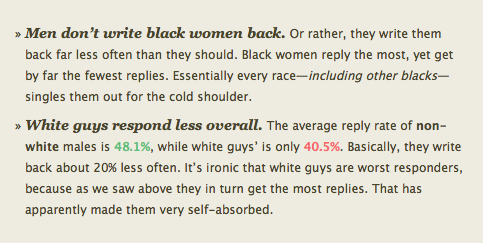
Here are the results of an OKCupid survey on the relationship between the race of the person messaging and likeliness the person will message them back:
I don't know how people discern their preference to date only one, two or three races from racism in its purist form. When challenged on it, men often say they are just picking physical criteria, like preferring blue eyes or blonde hair. But it isn’t, considering how these characteristics vary so widely from within one race. A Hispanic woman can have blonde hair, but it often isn’t blonde hair that these men are worshipping, it’s the idea of whiteness itself.
Historically, white and Asian women have been “awarded” all of the femininity stereotypes, such as being perceived as innately demure, and nurturing. If a man is interested in dating only white women and/or Asian women, it is a red flag to me that not only is this person racist, which is bad enough, but he is likely a misogynist as well. It tells me that this man is looking for a woman who fits a narrow definition of femininity, one that reduces me to the Madonna side of the Madonna/Whore complex.
Conversely, black women are portrayed as my fellow student expressed. They have an “attitude,” which is code for “emasculating.” Black women (as well as Hispanic women) have also been labeled as promiscuous and less intelligent. If you have any doubt, look at Gone With The Wind, with its masculine Mammy or dumb and irresponsible Prissy or more recently Ally McBeal's independent and flirtatious best friend Renee, whose overt sexuality lands her in trouble and Modern Family's bubbly and irrational Gloria.
I'm surprised, though perhaps it's naive, that some of my white feminist friends aren't really appalled by the "preference" problem. Whatever gender biases white women face, women of color face them to a magnified degree. Every gender stereotype, from being manipulative to too masculine, are all charges men level at women of all colors when they wish to minimize our power. By not challenging the preference statement, due to some unconscious apathy or their own inner racism, white feminists are supporting another system of inequality as well as supporting the same gender tropes they also suffer from.


 (Originally published 11/9/2012)